
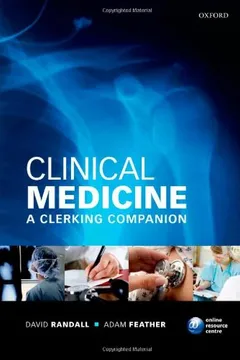
Livro Clinical Medicine: A Clerking Companion
Students starting on the wards are often bewildered at their role and unable to make the most of the learning opportunities presented to them. The hardest thing is to adapt to a new way of learning, where books and lectures take a back seat and the subjects for study are the patients whose beds line the wards.
Rather than being asked to go to the library and write an essay on the physiology of the kidneys, you are told to go and clerk the patient in bed 3 with acute renal failure.
The problem lies in knowing where on earth to begin. Clinical Medicine: A Clerking Companion is written for inexperienced clinical students, and helps them to use their patients to learn medicine.
It aims to transform students who know a bit about the medical sciences into young doctors who can draw knowledge and experience together to diagnose and treat real patients. At heart, it is a workbook that provides students with a framework for approaching patients with a range of common conditions.
It is a 'friend over the shoulder' - guiding students through interviewing and examining a patient, and then evaluating the patient's current condition and their future management. A list of questions then helps students explore the topic in more detail - sending them back to their textbooks to read about what they have seen and understand the science underlying it.
It is also a self-directed learning portfolio, helping students to assess their progress by seeing where they are lacking clinical exposure, and by recording key cases they have seen to function as a revision aid.
Clinical Medicine: A Clerking Companion falls into three main sections. The introduction explains briefly how to use the book to make the most of time spent on the wards - how to interview and examine patients, how to use the book in recording findings, and then how to present patients to doctors.
It emphasises the importance of anonymising patient information and ensuring patient consent before interviewing and examining them. The section on presentations covers over 30 undiagnosed presenting complaints such as 'chest pain' or 'acute confusion', suitable for use in A+E or in outpatient.
Proformas for each presentation take students through the dynamic process of diagnosis and initial management. The largest section, conditions, covers around 100 common medical and surgical problems, grouped according to speciality.
Each chapter (for instance 'cardiology') begins with an introductory section offering basic approaches to the symptoms, signs and investigations encountered in that specialty - for instance, how to recognise common murmurs or a simple guide to reading an ECG.
The subsequent clerking proformas are similar to those for the clinical 'presentations', allowing students to interview and examine ward patients who already have an established diagnosis, reviewing their investigation results, and then evaluating the severity, aetiology and management of the condition.
The book aims to: DT Transform patients into useful learning resources: helping students to use patients to develop skills and build knowledge.DT Be a 'near patient resource': something to be carried onto the ward and used when seeing patients.DT Enable students to be pro-active: Lots of time can be wasted as a medical student waiting for doctors to be free to teach you.
This allows even very junior students to get on with clerking and evaluating patients.DT Build student confidence: Presenting patients you have clerked to senior doctors can be daunting. With this book students can do so more confidently knowing that they have at least covered all the more important points.DT Train students to think clinically: So much of medical education involves teaching a mindset - actively resuscitating a patient whilst also trying to diagnose them, or weighing the relative importance of various pieces of information.
Other books present information - this book teaches students to use it. A completely new concept, with a unique focus on the learning needs of inexperienced students, Clinical Medicine: A Clerking Companion is the one friend you won't want to be without as you begin your journey onto the wards.
Online Resource CentreThe Online Resource Centre to accompany Clinical Medicine: A Clerking Companion features: DT Dynamic, annotated figures - enlarged, fully annotated copies of key images from the book, including ECGs and X-rays.DT PDFs of the proformas in the book, avalible to download
Quer ler o livro completo?
Ficha Técnica do Livro
Veja abaixo alguns detalhes e características deste livro. Aproveite para indicar ou não indicar a obra, ajudando assim toda a comunidade leitora.
| Autor(es) | |
| Editora | Oxford University Press, USA |
| Idioma | Inglês |
| ISBN | 0199574375 9780199574377 |
| Formato | Capa comum |
| Páginas | 304 |

Versão em PDF
Quer salvar o resumo deste livro em PDF? Simples, clique no botão abaixo e salve o arquivo em seu computador. Lembrando que você pode distribuir este arquivo livremente sempre que quiser.
⚠️ Versões em PDF na internet podem estar incompletas ou desatualizadas.
📘 A versão completa e atualizada está disponível na Amazon:
- ✔ versão completa
- ✔ conteúdo atualizado
- ✔ acesso oficial
Se preferir, você pode baixar um resumo em PDF abaixo.
 Salvar PDF
Nota ao autor: fique despreocupado pois somos totalmente contra a pirataria. Os resumos disponibilizados aqui ajudam o leitor a conhecer um pouco do seu livro e por fim incentivam a compra, te possibilitando um marketing gratuito e alavancando suas vendas. Caso queira entrar em contato conosco utilize o link no rodapé da página.
Opiniões sobre o livro
Clique no botão abaixo para saber o que as pessoas estão achando do livro Clinical Medicine: A Clerking Companion. Veja opiniões, e caso se sinta à vontade, deixe a sua também.