
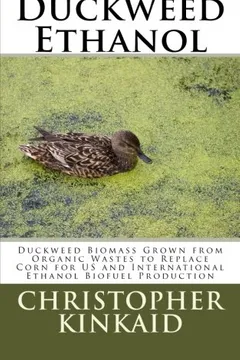
Livro Duckweed Ethanol: Duckweed Biomass Grown from Organic Wastes to Replace Corn for Us and International Ethanol Biofuel Production
The smallest flowering plant, on Earth, is one of the most powerful, and widespread: duckweed. Usually, considered a nuisance, duckweed, upon close examination, is an impressive crop, in photosynthetic value.
Ethanol, an industry dominated by the Corn Industry (King Corn), faces many challenges, including large water draws, rising fertilizer costs, large diesel fuel bills, and unintended impacts on Food markets.
Corn, as a choice for ethanol production, pits food, versus fuel, for agricultural resources, increasing stresses between fundamental markets. An ideal source of biomass, for ethanol production, would not be a food crop, rather, a waste-crop.
King Corn, dominates current domestic ethanol production markets, worth billions, each year. Supported with Federal Farm Subsidies, worth billions of dollars annually, the corn industry dictates the US ethanol markets, using Corn as the principle feedstock crop.
At first glance, Corn, is an odd choice for ethanol production. Corn, began as a wild seed crop, domesticated by ancient man. Before the modern age, thousands of years of selective breeding, produced a Corn rich in proteins, and high in nutritional value.
Modern Corn, has been engineered to go �the other direction,� and reduce Corn�s Protein, and increase Corn�s Starch (Carbohydrate) production. The �Starch� in corn, is used for Ethanol production, and other by-products, such as Corn Syrup, and Distillers Dried Grains and Solubles (DDGS).
Duckweed, is a choice for bulk biomass, which offers significant advantages over corn. Duckweed advantages include, lower energy costs, lower water resources, lower fertilizer costs, doesn�t require valuable farmland, doesn�t compete in Food markets, has higher Starch yield, per acre.
Duckweed, in a controlled environment, can be grown, year round, and in diverse locations. Corn, as a bulk source of Starch production, competes with Food markets, drinks thousands of gallons of water, per gallon Ethanol produced, requires large diesel fuel bills for growing, and harvesting, requires large amounts of fertilizers, and lower�s the nutritional value of Corn on purpose, to produce more starch, reducing protein production, and nutritional value.
Quer ler o livro completo?
Ficha Técnica do Livro
Veja abaixo alguns detalhes e características deste livro. Aproveite para indicar ou não indicar a obra, ajudando assim toda a comunidade leitora.
| Autor(es) | |
| Editora | Createspace |
| Idioma | Inglês |
| ISBN | 1500485764 9781500485764 |
| Formato | Capa comum |
| Páginas | 62 |

Versão em PDF
Quer salvar o resumo deste livro em PDF? Simples, clique no botão abaixo e salve o arquivo em seu computador. Lembrando que você pode distribuir este arquivo livremente sempre que quiser.
⚠️ Versões em PDF na internet podem estar incompletas ou desatualizadas.
📘 A versão completa e atualizada está disponível na Amazon:
- ✔ versão completa
- ✔ conteúdo atualizado
- ✔ acesso oficial
Se preferir, você pode baixar um resumo em PDF abaixo.
 Salvar PDF
Nota ao autor: fique despreocupado pois somos totalmente contra a pirataria. Os resumos disponibilizados aqui ajudam o leitor a conhecer um pouco do seu livro e por fim incentivam a compra, te possibilitando um marketing gratuito e alavancando suas vendas. Caso queira entrar em contato conosco utilize o link no rodapé da página.
Opiniões sobre o livro
Clique no botão abaixo para saber o que as pessoas estão achando do livro Duckweed Ethanol: Duckweed Biomass Grown from Organic Wastes to Replace Corn for Us and International Ethanol Biofuel Production. Veja opiniões, e caso se sinta à vontade, deixe a sua também.